Blog

Lubrication and Reliability Centered Maintenance: Why Lubrication Still Tops Failure Lists

See how lubrication, oil analysis, and condition based maintenance strengthen reliability centered maintenance programs and reduce equipment failure.
Date Published
December 8, 2025

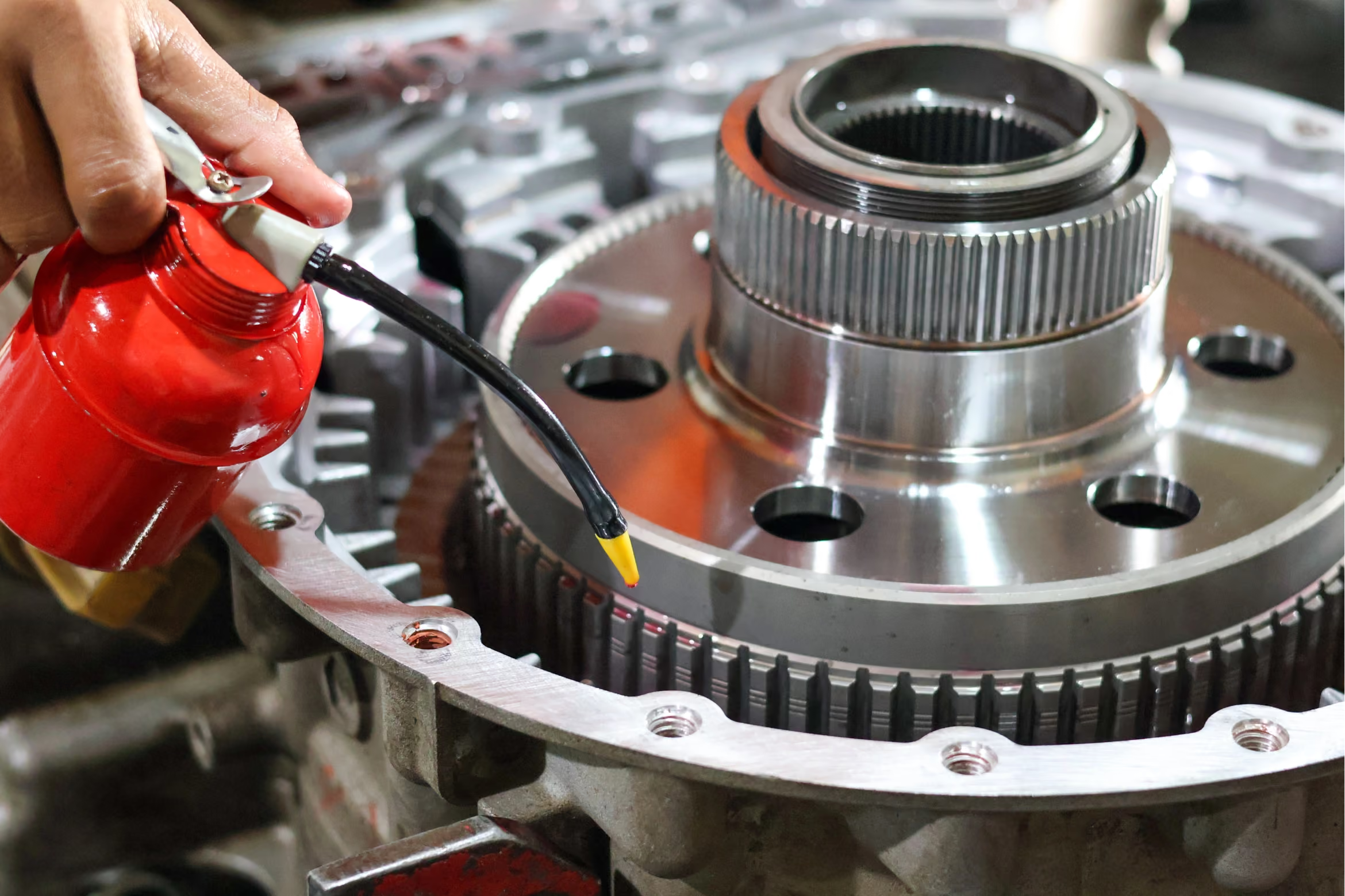
Most failures don’t begin with a loud bang. They start with something deceptively small: a lubricant that’s contaminated, breaking down, or simply the wrong fit for the job.

Even the strongest RCM (reliability centered maintenance) programs can get tripped up by wrong lubricants, inconsistent schedules, contamination, or oil analysis that gets skimmed instead of truly interpreted. When lubrication slips, the entire maintenance program feels it.

In this post, we'll break down why lubrication still ranks among the top causes of asset failure, how it connects to a successful reliability centered maintenance program, and why pairing oil analysis with vibration monitoring gives you the most complete, condition-based view of your asset health.

What Is Reliability Centered Maintenance (RCM), and Where Does Lubrication Fit?

A reliability centered maintenance (RCM) analysis is a highly customized process with a unique approach for each asset that's tailored to its usage, key component parts, and unique threats to usability. The RCM process is designed to:

  • Identify system functions
  • Pinpoint the critical failure modes that threaten those functions
  • Evaluate the consequences of those failures
  • Determine the most cost-effective maintenance strategies to prevent them

Teams implement reliability centered maintenance to ensure that maintenance efforts are both efficient and effective, reducing costs while maximizing asset performance. Done well, an RCM program drives all these gains while giving maintenance teams a clear path toward continuous improvement.

But here’s the part many organizations miss: lubrication affects nearly every major failure mode associated with rotating equipment. If lubrication fundamentals aren’t solid, no RCM strategy—no matter how thorough—can deliver its full value.

Want to explore how predictive maintenance strategies support a stronger, more cost-effective RCM strategy? Take a look at our predictive maintenance AI overview.

Why Lubrication Still Tops Failure Lists

Lubrication is so foundational that it quietly shapes every metric: performance standards, maintenance costs, asset availability, and long-term system reliability. Yet it’s still one of the most overlooked maintenance activities. Even the most skilled maintenance teams can underestimate what poor lubrication does across the production line.

The hidden costs of poor lubrication

Most lubrication-related failures are preventable. The costs stack up as small errors such as contamination, incorrect viscosity, and missing early wear indicators compound over time.

  • Lost production from unplanned downtime
  • Increased scrap and product spoilage
  • Higher repair costs and spare parts usage
  • Emergency labor and overtime
  • Excess energy consumption from increased friction
  • Accelerated wear that shortens the useful life of critical assets

Here are some eye-opening estimates of the damage that lubrication issues cause:

Up to 70% of equipment failures are lubrication related 80% of bearing failures stem from improper lubrication practices
$240B in annual downtime and repair costs for U.S. manufacturers are tied to poor lubrication 23% of global energy consumption is due to wear and friction, and poor lubrication alone can inflate facility energy use by up to 20%

How lubrication directly shapes RCM outcomes

Clearly, lubrication is a primary failure driver. And when you think in terms of RCM evaluation criteria, the condition of your oil is directly tied to:

  • Functional failure (loss of required function)
  • Failure modes (bearing wear, overheating, contamination, viscosity breakdown)
  • System failures (cascading breakdowns across interconnected assets)
  • Cost effectiveness (predictive vs. preventive maintenance vs. reactive repair costs)
  • Maintenance performed proactively rather than after failure occurs

This makes lubrication a strategic leverage point. Following lubrication best practices and going beyond the red, yellow, and green in your oil analysis reports is key to optimizing RCM program results.

Want to see how a holistic, end-to-end predictive maintenance solution empowers teams to identify preventable failures early? Here's a detailed look at how cloud-based software and U.S.-based support combine to make the transition easy.

Oil Analysis: The RCM Multiplier Most Teams Underutilize

A reliability centered maintenance strategy depends on choosing the right maintenance tasks for each asset. Oil analysis is one of the most powerful condition-based maintenance tools you can use to support that process.

Without comprehensive, in-depth oil analysis, you're operating with visibility gaps. Red/yellow/green labels tend to oversimplify asset condition and hide early, actionable warnings such as subtle changes in wear metals, viscosity shifts, or contamination levels that often never trigger a color change. And without the ability to identify trends, teams can’t see accelerating wear or emerging failure modes.

When oil analysis becomes a strategic, trended data source, you'll have:

  • Visibility into wear particles indicating internal component wear
  • Insights about contamination (water, dirt, coolant, cross-contamination)
  • Lubricant health including oxidation, additive depletion, and viscosity changes
  • Remaining useful life estimates that help you schedule maintenance with precision

Here's a real-world example of the value of oil analysis. When early warnings in oil analysis data were overlooked, a $150,000 gearbox lost over half its value due to a wear rate running 261% above normal. That's over five years of asset life lost, when a timely response at the first signs of low viscosity and particle buildup could have prevented the damage.

Oil analysis, interpreted correctly and acted upon quickly, changes the entire trajectory of asset life—and your maintenance costs along with it.

With simple lubrication changes, facility teams are achieving significant saves and extending asset life by years. ⬇️ Download our lubrication guide to see how comprehensive oil analysis and dedicated expert support work together to transform reliability.

Why Vibration + Oil Analysis = Reliability Centered Maintenance at Its Best

Vibration monitoring and oil analysis are complementary tools that work together to provide a holistic view of asset health. Vibration monitoring tells you what is happening mechanically, while oil analysis shows you why.

Condition Monitoring What vibration monitoring detects Lubrication Analysis Root causes identified through oil analysis
  • Imbalance
  • Misalignment
  • Looseness
  • Bearing or gear mesh abnormalities
  • Wear particles from deteriorating components
  • Viscosity breakdown
  • Water contamination
  • Additive depletion
  • Incorrect lubricant

When both signals are integrated in the same condition monitoring program, teams close the visibility gaps that lead to reactive maintenance. In one case, $897,600 was saved and 336 hours of downtime were avoided when vibration flagged abnormal wear and oil analysis confirmed contamination and degraded viscosity in an extruder. This is a classic example of how proactive, condition based maintenance tasks outperform run-to-failure approaches every time.

Want a deeper look at how vibration, oil analysis, and expert insight work together to prevent failures you can’t see coming? 👉 Explore the full visibility guide.

How Lubrication Strengthens an Entire Reliability Centered Maintenance Program

A strong lubrication strategy supports every pillar of RCM.

1. Reduces maintenance costs

With correct lubrication and trended oil analysis, you eliminate premature wear and extend the intervals between overhauls, directly cutting repair costs and unnecessary maintenance activities.

2. Improves equipment reliability

Because most rotating equipment failure modes originate with friction, wear, heat, or contamination, lubrication directly improves asset condition and system reliability.

3. Helps identify failure modes early

Oil analysis reveals early evidence of the most common RCM failure modes (bearing wear, gear degradation, contamination, oxidation, viscosity breakdown) long before failure occurs.

4. Enables condition based maintenance

RCM emphasizes suitable proactive tasks, not blanket scheduled maintenance. Oil analysis gives you the real-time condition data required to perform the right task at the right time.

5. Supports continuous improvement

Once lubrication performance is monitored, trended, and tied to KPIs, teams can refine processes, improve training, reduce maintenance backlog, and accelerate RCM program maturity.

Learn how Worthington Steel extended total asset life by 12.5 years and achieved 15x ROI by adding comprehensive oil analysis to its condition monitoring mix. 💡Read the case study here.

Treat Lubrication as a Core Performance Engine

Lubrication is one of the most cost-effective ways to improve equipment availability, reduce operational costs, and strengthen your entire reliability centered maintenance strategy.

When you combine the following, you build a maintenance program and culture that create the conditions for making zero unplanned downtime an achievable goal.

  • Smart lubrication practices
  • Trending oil analysis beyond red/yellow/green
  • Real-time vibration monitoring
  • Ongoing support from a dedicated expert
  • Centralized visibility into asset health

More importantly, you protect the performance and longevity of your physical assets while giving your maintenance teams the clarity and confidence to act decisively.

Learn the Steps to Lubrication Excellence

If you’re ready to reduce maintenance costs, improve equipment reliability, and strengthen your reliability centered maintenance program through better lubrication practices, our e-book How to Optimize Your Lubrication Program for Maximum Uptime & Asset Life can help. It’s packed with real-world case studies, best practices, and step-by-step guidance that can help you measure impact. 👉 Get your copy today.

e-book

How to Optimize Your Lubrication Program for Maximum Uptime & Asset Life
Upcoming Predictive Maintenance & Condition Monitoring Events

Discover the latest strategies in asset reliability and downtime reduction—browse our featured sessions below or view all upcoming events.


Machinery Lubrication Engineer
Training
Dec 8, 2025
Tulsa, OK
International Maintenance Conference 2025
Trade Show
Dec 8, 2025
Marco Island, FL
Machinery Lubrication I
Training
Dec 9, 2025
Tulsa, OK

Predictive Maintenance Resources

Unlock expert strategies for better asset health—read our featured guides below or browse the full knowledge center.

The more we know about your business the more we can save your organization with proactive maintenance.

GET STARTED

Tell us about your organization

All Blog Posts

Lubrication and Reliability Centered Maintenance: Why Lubrication Still Tops Failure Lists

December 8, 2025

See how lubrication, oil analysis, and condition based maintenance strengthen reliability centered maintenance programs and reduce equipment failure.

Most failures don’t begin with a loud bang. They start with something deceptively small: a lubricant that’s contaminated, breaking down, or simply the wrong fit for the job.

Even the strongest RCM (reliability centered maintenance) programs can get tripped up by wrong lubricants, inconsistent schedules, contamination, or oil analysis that gets skimmed instead of truly interpreted. When lubrication slips, the entire maintenance program feels it.

In this post, we'll break down why lubrication still ranks among the top causes of asset failure, how it connects to a successful reliability centered maintenance program, and why pairing oil analysis with vibration monitoring gives you the most complete, condition-based view of your asset health.

What Is Reliability Centered Maintenance (RCM), and Where Does Lubrication Fit?

A reliability centered maintenance (RCM) analysis is a highly customized process with a unique approach for each asset that's tailored to its usage, key component parts, and unique threats to usability. The RCM process is designed to:

  • Identify system functions
  • Pinpoint the critical failure modes that threaten those functions
  • Evaluate the consequences of those failures
  • Determine the most cost-effective maintenance strategies to prevent them

Teams implement reliability centered maintenance to ensure that maintenance efforts are both efficient and effective, reducing costs while maximizing asset performance. Done well, an RCM program drives all these gains while giving maintenance teams a clear path toward continuous improvement.

But here’s the part many organizations miss: lubrication affects nearly every major failure mode associated with rotating equipment. If lubrication fundamentals aren’t solid, no RCM strategy—no matter how thorough—can deliver its full value.

Want to explore how predictive maintenance strategies support a stronger, more cost-effective RCM strategy? Take a look at our predictive maintenance AI overview.

Why Lubrication Still Tops Failure Lists

Lubrication is so foundational that it quietly shapes every metric: performance standards, maintenance costs, asset availability, and long-term system reliability. Yet it’s still one of the most overlooked maintenance activities. Even the most skilled maintenance teams can underestimate what poor lubrication does across the production line.

The hidden costs of poor lubrication

Most lubrication-related failures are preventable. The costs stack up as small errors such as contamination, incorrect viscosity, and missing early wear indicators compound over time.

  • Lost production from unplanned downtime
  • Increased scrap and product spoilage
  • Higher repair costs and spare parts usage
  • Emergency labor and overtime
  • Excess energy consumption from increased friction
  • Accelerated wear that shortens the useful life of critical assets

Here are some eye-opening estimates of the damage that lubrication issues cause:

Up to 70% of equipment failures are lubrication related 80% of bearing failures stem from improper lubrication practices
$240B in annual downtime and repair costs for U.S. manufacturers are tied to poor lubrication 23% of global energy consumption is due to wear and friction, and poor lubrication alone can inflate facility energy use by up to 20%

How lubrication directly shapes RCM outcomes

Clearly, lubrication is a primary failure driver. And when you think in terms of RCM evaluation criteria, the condition of your oil is directly tied to:

  • Functional failure (loss of required function)
  • Failure modes (bearing wear, overheating, contamination, viscosity breakdown)
  • System failures (cascading breakdowns across interconnected assets)
  • Cost effectiveness (predictive vs. preventive maintenance vs. reactive repair costs)
  • Maintenance performed proactively rather than after failure occurs

This makes lubrication a strategic leverage point. Following lubrication best practices and going beyond the red, yellow, and green in your oil analysis reports is key to optimizing RCM program results.

Want to see how a holistic, end-to-end predictive maintenance solution empowers teams to identify preventable failures early? Here's a detailed look at how cloud-based software and U.S.-based support combine to make the transition easy.

Oil Analysis: The RCM Multiplier Most Teams Underutilize

A reliability centered maintenance strategy depends on choosing the right maintenance tasks for each asset. Oil analysis is one of the most powerful condition-based maintenance tools you can use to support that process.

Without comprehensive, in-depth oil analysis, you're operating with visibility gaps. Red/yellow/green labels tend to oversimplify asset condition and hide early, actionable warnings such as subtle changes in wear metals, viscosity shifts, or contamination levels that often never trigger a color change. And without the ability to identify trends, teams can’t see accelerating wear or emerging failure modes.

When oil analysis becomes a strategic, trended data source, you'll have:

  • Visibility into wear particles indicating internal component wear
  • Insights about contamination (water, dirt, coolant, cross-contamination)
  • Lubricant health including oxidation, additive depletion, and viscosity changes
  • Remaining useful life estimates that help you schedule maintenance with precision

Here's a real-world example of the value of oil analysis. When early warnings in oil analysis data were overlooked, a $150,000 gearbox lost over half its value due to a wear rate running 261% above normal. That's over five years of asset life lost, when a timely response at the first signs of low viscosity and particle buildup could have prevented the damage.

Oil analysis, interpreted correctly and acted upon quickly, changes the entire trajectory of asset life—and your maintenance costs along with it.

With simple lubrication changes, facility teams are achieving significant saves and extending asset life by years. ⬇️ Download our lubrication guide to see how comprehensive oil analysis and dedicated expert support work together to transform reliability.

Why Vibration + Oil Analysis = Reliability Centered Maintenance at Its Best

Vibration monitoring and oil analysis are complementary tools that work together to provide a holistic view of asset health. Vibration monitoring tells you what is happening mechanically, while oil analysis shows you why.

Condition Monitoring What vibration monitoring detects Lubrication Analysis Root causes identified through oil analysis
  • Imbalance
  • Misalignment
  • Looseness
  • Bearing or gear mesh abnormalities
  • Wear particles from deteriorating components
  • Viscosity breakdown
  • Water contamination
  • Additive depletion
  • Incorrect lubricant

When both signals are integrated in the same condition monitoring program, teams close the visibility gaps that lead to reactive maintenance. In one case, $897,600 was saved and 336 hours of downtime were avoided when vibration flagged abnormal wear and oil analysis confirmed contamination and degraded viscosity in an extruder. This is a classic example of how proactive, condition based maintenance tasks outperform run-to-failure approaches every time.

Want a deeper look at how vibration, oil analysis, and expert insight work together to prevent failures you can’t see coming? 👉 Explore the full visibility guide.

How Lubrication Strengthens an Entire Reliability Centered Maintenance Program

A strong lubrication strategy supports every pillar of RCM.

1. Reduces maintenance costs

With correct lubrication and trended oil analysis, you eliminate premature wear and extend the intervals between overhauls, directly cutting repair costs and unnecessary maintenance activities.

2. Improves equipment reliability

Because most rotating equipment failure modes originate with friction, wear, heat, or contamination, lubrication directly improves asset condition and system reliability.

3. Helps identify failure modes early

Oil analysis reveals early evidence of the most common RCM failure modes (bearing wear, gear degradation, contamination, oxidation, viscosity breakdown) long before failure occurs.

4. Enables condition based maintenance

RCM emphasizes suitable proactive tasks, not blanket scheduled maintenance. Oil analysis gives you the real-time condition data required to perform the right task at the right time.

5. Supports continuous improvement

Once lubrication performance is monitored, trended, and tied to KPIs, teams can refine processes, improve training, reduce maintenance backlog, and accelerate RCM program maturity.

Learn how Worthington Steel extended total asset life by 12.5 years and achieved 15x ROI by adding comprehensive oil analysis to its condition monitoring mix. 💡Read the case study here.

Treat Lubrication as a Core Performance Engine

Lubrication is one of the most cost-effective ways to improve equipment availability, reduce operational costs, and strengthen your entire reliability centered maintenance strategy.

When you combine the following, you build a maintenance program and culture that create the conditions for making zero unplanned downtime an achievable goal.

  • Smart lubrication practices
  • Trending oil analysis beyond red/yellow/green
  • Real-time vibration monitoring
  • Ongoing support from a dedicated expert
  • Centralized visibility into asset health

More importantly, you protect the performance and longevity of your physical assets while giving your maintenance teams the clarity and confidence to act decisively.

Learn the Steps to Lubrication Excellence

If you’re ready to reduce maintenance costs, improve equipment reliability, and strengthen your reliability centered maintenance program through better lubrication practices, our e-book How to Optimize Your Lubrication Program for Maximum Uptime & Asset Life can help. It’s packed with real-world case studies, best practices, and step-by-step guidance that can help you measure impact. 👉 Get your copy today.

Our 30-day, risk free trial is only $199.

AssetWatch customers save on average 8x in ROI. That means for every $1 you give us, we give $8 back to you.

Includes professional installation of up to 200 sensors (a $10k+ value)

24/7 monitoring and a dedicated CME for your site

AssetWatch cloud-based software with unlimited licenses

No CapEx, Engineering or IT integration required